SALES & CRM
Your reps already know their accounts. Give them somewhere to put it.
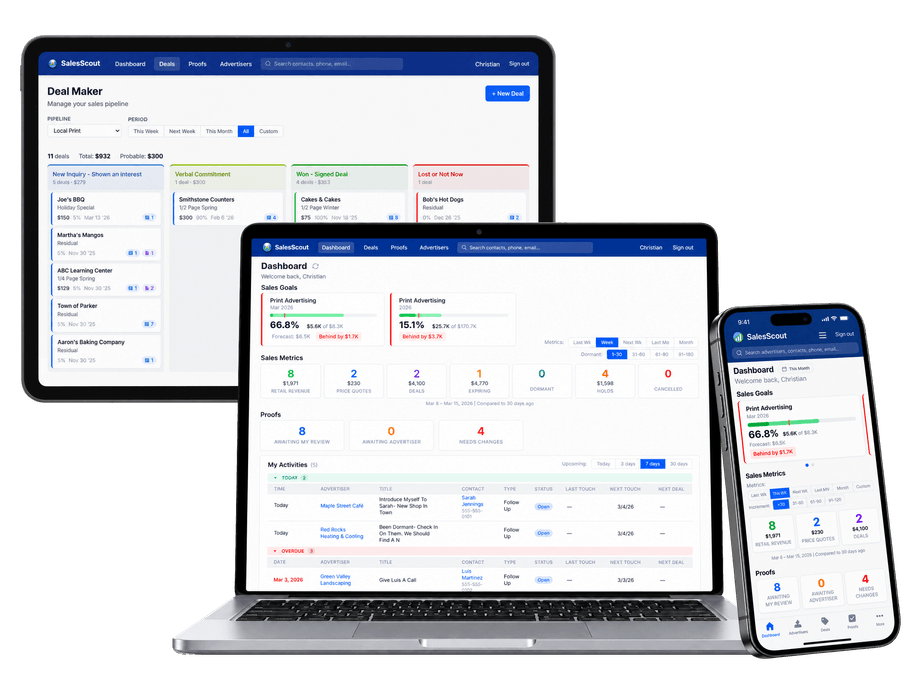
SalesScout keeps pipeline, quotes, call history, and contracts in the same system that bills the ad — so nothing has to be re-entered, and nothing walks out the door when a rep does.
THE PROBLEM
A spreadsheet, an inbox, and one rep's memory.
Most ad sales operations run on three things: a spreadsheet, an inbox, and one rep's memory. It works, right up until the rep is out sick, or leaves, or the publisher asks a simple question like what did we quote that account last year — and nobody can answer it without digging through email.
The general-purpose CRMs do not help. They are built to sell software subscriptions, not column inches. There is no concept of an issue date, a rate card, a contract with an insertion schedule, or an account that runs the same quarter-page every week for eleven years. So publishers either bend their business into someone else's fields, or they give up and go back to the spreadsheet.
And the CRM is disconnected from billing. A rep sells the ad in one place, someone re-types it into another, and the two versions drift apart until a customer disputes an invoice.
THE PUBLISHER'S VIEW
What the pipeline adds up to.
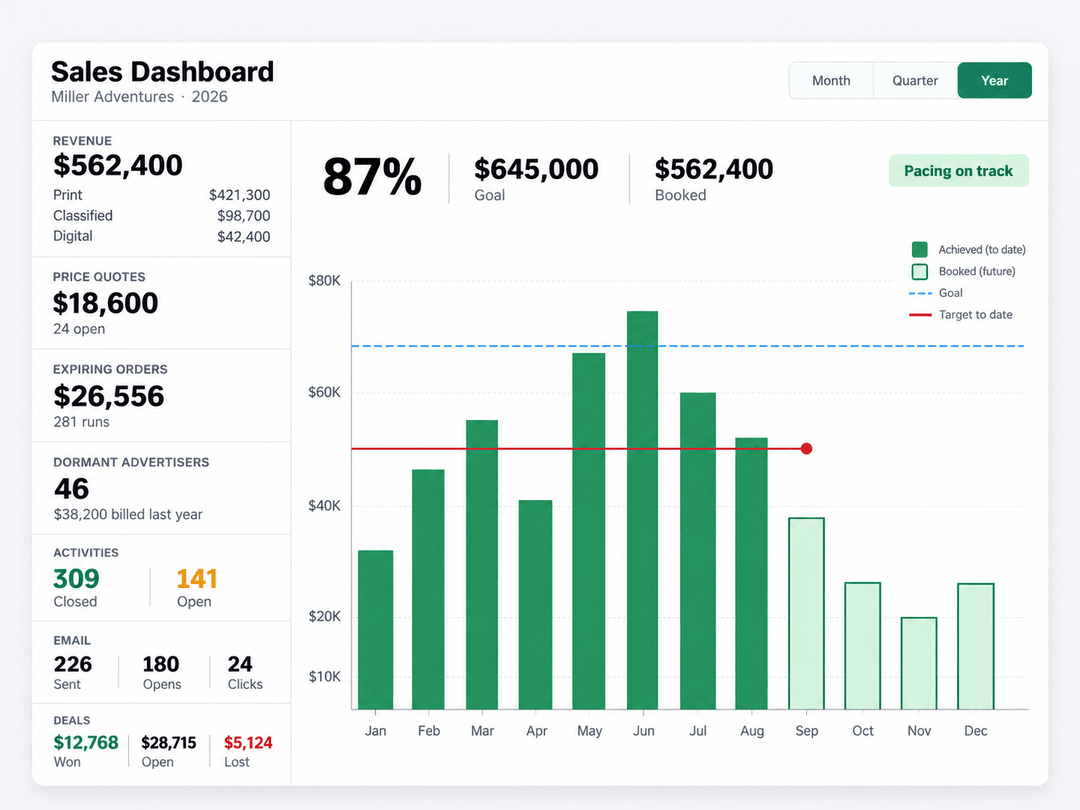
Reps sell into the same records the publisher reports from, so "are we ahead or behind" is a screen somebody opens rather than a Friday spent assembling a spreadsheet.
- Booked revenue charted month by month against goal and target-to-date
- Print, classified, and digital broken out the way the rate card sells them
- Open quotes, expiring orders, and dormant advertisers surfaced as work to do
FROM THE FIELD
The account history fits in a coat pocket.
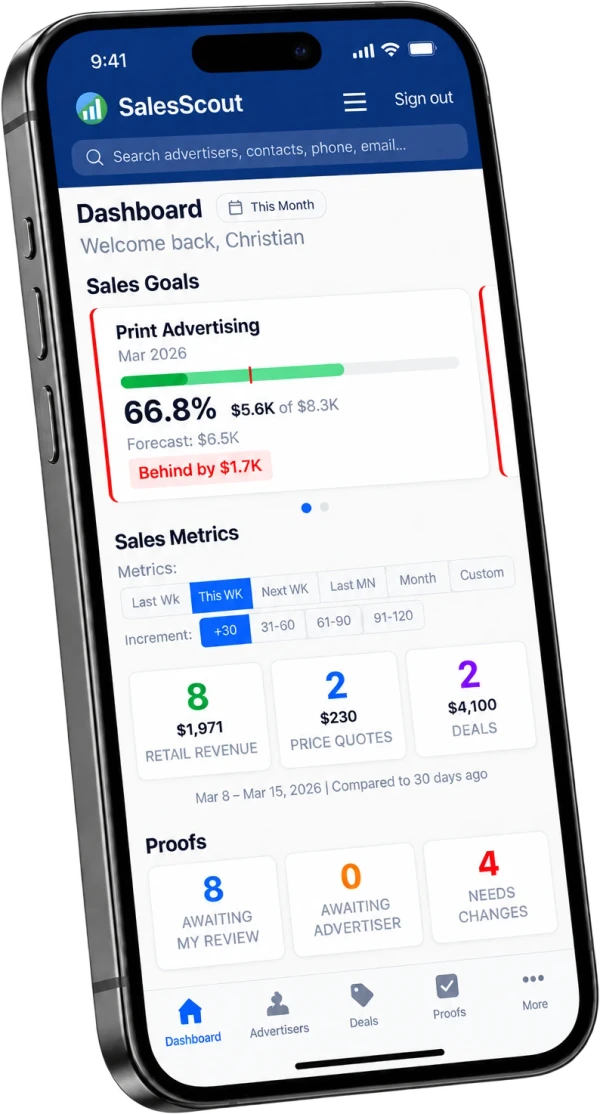
SalesScout installs as an app on a phone or tablet. A rep sitting outside a client's office can check where they are against goal and what is still waiting on a proof before they walk in.
- Goal pacing for the month, flagged when the rep is behind
- Quote and deal counts, and the proofs waiting on the rep's own review
- Advertisers, deals, and proofs one tap apart, on the records the office sees
WHAT THE SALE BECOMES
A package is one choice, not twenty-four line entries.
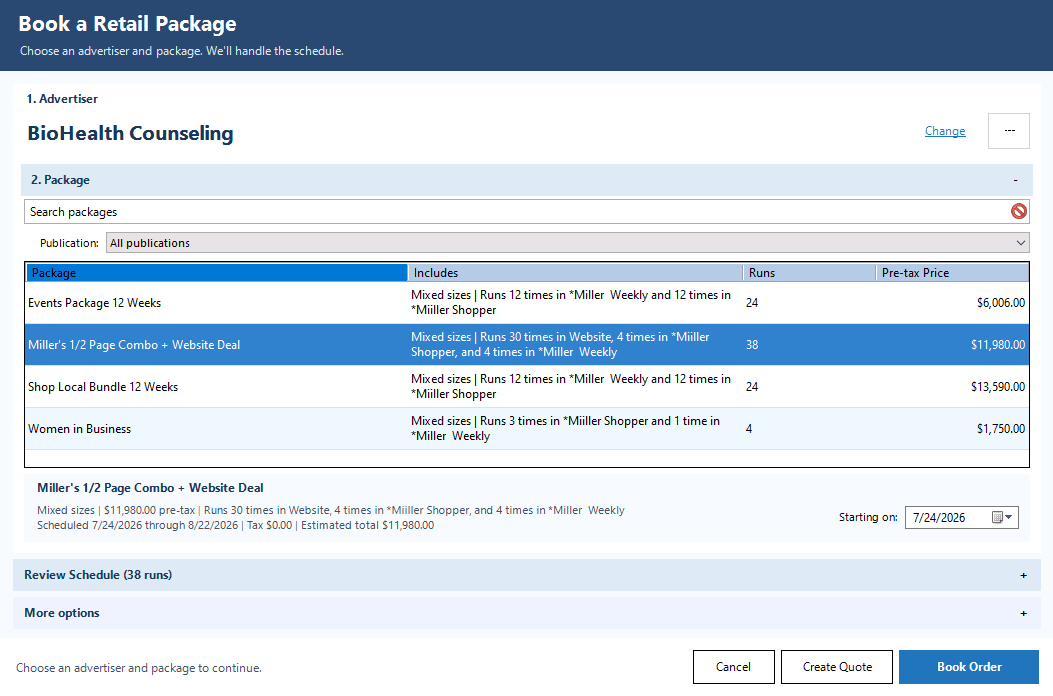
Packaged buys are where order entry usually turns into an afternoon - a run in one title, a different run in another, priced by hand and typed in date by date. Here the package carries its own schedule, and booking it writes every insertion.
- Packages list what they include, how many runs, and the pre-tax price before anything is booked
- One package spans several titles, so a combination buy is a single order rather than one per publication
- The schedule is generated from the package and shown for review before the order is written
WHAT CHANGES
One account history, and quotes that match the invoice.
- Every account has one history: calls, quotes, contracts, insertions, and payments in a single timeline
- Reps sell from the real rate card, not a copy of it, so quotes and invoices agree
- A signed contract becomes scheduled insertions without anyone re-keying it
- Reps work from a phone or tablet on a sales call, not from a printout
- When a rep leaves, the account relationship stays with the publication
HOW IT WORKS
From first call to booked insertion.
The same records the whole way through, so the order a rep sells is the order production sees and billing invoices.
- 1
The account already exists
SalesScout reads from the same customer records AccountScout bills against. There is no separate CRM database to sync, and no reconciliation step between what sales knows and what accounting knows.
- 2
Build a quote from live rates
Pull the current rate card, apply the frequency or contract discount, and send it. What the rep quotes is what the system will bill — the two cannot drift apart because they are the same record.
- 3
Log the conversation where it belongs
Calls, notes, and next steps attach to the account rather than to a rep's personal notebook. The next person to touch the account sees the whole history.
- 4
Turn the yes into an order
Accepted quotes become insertion schedules on real issue dates. Production sees the order; billing sees the receivable. Nobody re-types anything.
- 5
Work it from the field
SalesScout installs as an app on a phone or tablet, so a rep sitting outside a client's office can check what ran last month before walking in.
PROOF
"I only use the AccountScout Mobile app. I don't have time to go into the office. I drive 1,000 miles a week, I use it everyday. It's Fake Brains at your fingertips."
- 300+
- Built-in reports, including pipeline, rep performance, and year-over-year account revenue — without exporting to a spreadsheet.
- Since 1991
- Built in-house in Colorado for newspaper and media publishers.
WHERE IT CONNECTS
The rest of the account lives next door.
Newspaper advertising software
The billing and receivables system the pipeline feeds, and the record every order lands in.
ExploreAdvertiser email marketing
Turn a segment of accounts — lapsed, seasonal, past due — into an outreach campaign.
ExploreSelf-service advertiser portal
Let the advertiser see their own history and pay online, without a phone call to the office.
ExploreCOMMON QUESTIONS
Questions publishers ask about ad sales CRM.
The rest of the workflow
See It In Action
Show us how your reps sell today
Bring your rate card and your current process. We will walk through where SalesScout fits your workflow — and tell you if it doesn't.