AccountScout Mobile: selling from the field
Why we put the full advertiser record — balances, run history, expiring orders, and the actual ad artwork — on a phone. This product is now SalesScout.
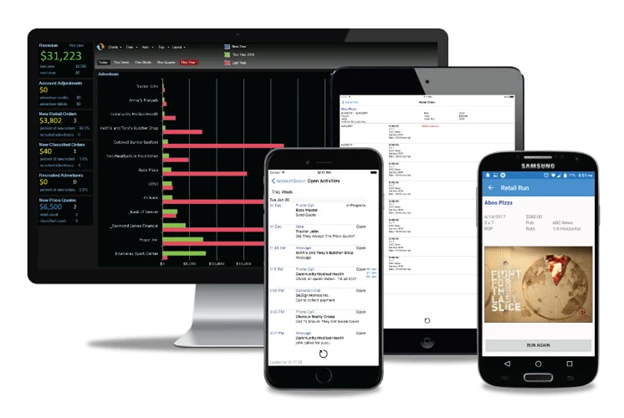
AccountScout Mobile was designed to keep sales reps in the field and close more deals.
The premise was simple: a rep should not have to drive back to the office to answer a question. The app connected to the same database as the desktop product every other department used, so a rep could pull up an advertiser and see the contact, recent activities, up-to-the-minute balances, recent ad runs, ad scheduling, advertiser metrics, expiring retail orders — and the actual ad copy of the ads.
Nearly everything visible at a desk, visible in a pocket, against live data rather than a nightly export.
Why a CRM at all
It is fair to say most publishers understand the importance of their reps. The question is what you hand them.
A CRM is how reps nurture prospects and keep customers. When you are choosing publishing software, it is easy to weigh the needs of billing and production — the departments that shout — and underweight the reps, who are usually out of the building when the decision gets made.
Our view then, and now: the most useful CRM for a publisher is the one that keeps reps in the field longer, gives them the data each conversation actually needs, and helps them close. It is not a separate system that someone has to reconcile later.
A story about Bob
Bob is a rep working past customers.
At this point Bob does not have AccountScout — he has a generic CRM on his phone. He knows the contact, he knows the advertiser, he knows they have bought before. He walks into the local pizza place and does what Bob does best: he sells an ad. A rerun of what they ran last time.
Back at the office, Bob enters the order and discovers he has just sold the same ad to the same business at a lower rate than they paid last time.
Now rewrite it. Bob is sitting outside with the app open, wondering who to call on. He taps "expiring retail orders" and sees a pizza place nearby with an ad about to lapse. He opens the advertiser and sees what he would see at his desk — the expiring ad, the price they paid, the contact, the account history, and, most usefully, the artwork currently running.
Bob still does what Bob does best. But this time he sells a larger ad at a higher rate, because he could see what they last bought and what they paid for it. Then he reruns the order from the app and moves on to the next expiring advertiser without going back to the office.
The difference between the two versions of that afternoon is not effort. It is information, at the moment it was needed.
About Fake Brains
Fake Brains has built software for newspaper and media publishers since 1991, and we write all of it in-house in Colorado. Everything we make is for this industry — every upgrade is meant to help publishers get more done and make more money.
Some of you love our name. Some of you do not. Either way, we enjoy helping newspaper communities, and we are the artificial intelligence behind your data.
Related reading
SalesScout — the ad sales CRM this became
The current product: the full CRM in a browser on any device, included with AccountScout.
For sales teams
What the day looks like for a rep working accounts away from the office.
Newspaper advertising software
The platform behind it: one advertiser record shared by sales, production, and billing.